Cultural Controls
Avoid Excess Nitrogen
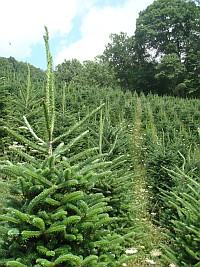
Aphids are typically more of a problem when plants are fertilized excessively with nitrogen fertilizer. This is because the added nutrition is also a nutritional bonus for the pest. As Christmas trees near harvest and get larger, their nitrogen needs become greater and it is more important to maintain a good green color. In order to maintain high enough nitrogen levels and yet reduce the impact of nitrogen on aphid pests, consider splitting the nitrogen application between the spring and early fall
Maintaining Good Groundcovers
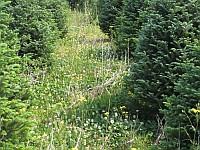
Ground covers supply habitat for natural predators. There are many predators that feed on aphids including lady beetle adults and larvae, hover fly larvae and lacewing larvae. The adult hover flies and lacewings feed on pollen and nectar and not pests. By keeping flowering ground covers around trees, and field borders to grow up in grasses and flowers that are allowed to bloom and go to seed, a habitat for these important predators is provided.
When Chemical Control is Necessary
When to Treat for BTA
There is no reason to control BTA in young trees. If there is damage, the tree typically grows that much more the following year. Start treating for BTA the year before you will be cutting trees out of the block so that all trees will have two years of good growth when marketed.However, even if BTA control is important because of the time in the rotation, it's not necessary to get complete control. Studies have indicated that most consumers don’t view the needle curl associated with BTA as problematic when picking out their special tree. Most growers in western NC have indicated that they would market a tree that had 10% or more of the needles with curl. Therefore, 100% control of BTA is not necessary.
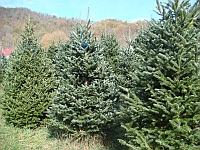
Damage that is found in the spring is typically gone by the time the foliage hardens off in the summer as long as there is enough rain for good shoot elongation.
These organic trees have never been treated in the spring for BTA, yet few trees have any damage. Organic growers of Fraser fir in western NC have found that if they do not treat for twig aphids, there is seldom much needle curl. There are enough predators to clean up the problem.
When to Treat for Cinara Aphids
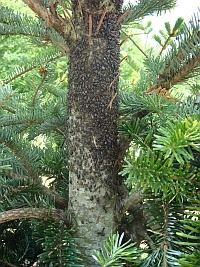
Cinara aphids attract predators because they live in large colonies. The aphid colony pictured here in May will certainly be gone by November. It is not necessary to control Cinara aphids in the spring and summer as they will not damage trees. However, if aphid colonies are found in blocks of trees to be harvested that year, many growers spot treat a few trees just to keep the population from potentially increasing in the fall.
It is recommended that all Fraser fir in western North Carolina be treated in the fall for Cinara aphids as a preventative treatment. Cinara aphids reproduce by having live young. Therefore even a few individual aphids at harvest may multiply rapidly in the home, causing a problem for the consumer. As the weather gets colder in the fall, many Cinara aphid colonies move lower into the tree, feeding on bottom branches where it is difficult to find them.
An important question is how early in the summer can you treat for Cinara aphids and get control. Most materials applied before August will not last long enough to control Cinara aphids. Treatments made in September and October should be sufficient to keep Cinara numbers from building back up unless there is a heavily infested block of trees close to the treated field.
Chemical Control of Aphids
Aphids can be controlled in Christmas trees with any application method. However, coverage is still important. If using an air-blast mistblower, do not try to treat too many rows at one time. Cinara aphids especially can be lower in the tree and difficult to reach.FALL TREATMENT WINDOW
In WNC, the only BTA life stage that remains after June are BTA eggs. In the past, twig aphid egg numbers could be lowered by fall applications of pyrethroids. However, due to resistance development, this is no longer possible. However, treating in the fall (end of September to harvest), provides the best control of Cinara aphids.| Pests Controlled | Treatment Description |
|---|---|
| BWA SSM Cinara aphids | SNIPER OR TALSTAR (or other bifenthrin product): Fall applications of bifenthrin products are best for controlling Cinara aphids as they have low mammalian toxicity. |
| BWA Cinara aphids | OTHER SYNTHETIC PYRETHROIDS such as ASANA: These products offer excellent Cinara aphid control. |
SPRING TREATMENT WINDOW
Growers have traditionally treated in the spring before bud break for BTA control. If only BTA and BWA is required, treating early in the year -- even in February -- can be effective. If you need to get control of EHS however, treat as close to bud break as possible to allow as many scale crawlers to emerge as possible| Pests Controlled | Treatment Description |
|---|---|
| BTA | SIVANTO: Silvano (ai: flupyradifurone) applied by itself will control BTA without harming natural predators or the parasitic wasp that controls scales. If mites are a problem, a miticide such as Envidor will have to be added. Flupyradifurone makes aphids stop feeding. Treatments need to be made a week or two before budbreak to be most effective. |
| BTA SSM (not eggs) HRM (not eggs) | DIMETHOATE: Dimethoate applied by itself will somewhat control BTA and provide a knock-down of both SSM and HRM. If mites are a problem, consider adding a miticide that controls eggs. |
| BWA BTA SSM | SNIPER: (ai: bifenthrin). BTA populations have been shown to have developed resistance to bifenthrin. However, bifenthrin will control BWA and SSM. The use of Sniper in the spring may make rust mites worse the following spring, so be sure to scout. Sniper use may control EHS crawlers or male fliers, but potentially also increase problems with EHS as the parasitic wasp will mostly be eliminated. |
| BWA BTA | ASANA: Asana is a pyrethroid like bifenthrin. Thus, BTA has likely developed resistance to this chemical as well. Asana has shown poor control of SSM |
| RBM BWA BTA | MOVENTO: Movento applied by itself will control BTA, BWA and RBM. Movento takes some time to be effective, so apply at least two weeks before budbreak. |
| BTA | ENDEAVOR: This product controls aphids by stopping their feeding activity. They may take several days to die, so don't expect a quick knock-down. It is recommended to apply well in advance of budbreak. Endeavor will not adversely affect natural predators or honeybees. If mites are present, add a miticide. ACEPHATE: Acephate will control twig aphids. However, if there are spider mites present, it will also increase numbers, so consider adding a miticide. |
| BWA BTA eggs HRM SSM eggs EHS (partial) Cinara aphids | HORTICULTURAL OIL: A 2% horticultural oil solution will control BWA nymphs. Applying oil in mid-March will also control BTA, HRM, and give some control of SSM and EHS. For more information on the use of oil, see: Organic Pest Control in Fraser Fir Christmas Trees. Cinara aphids will need to be controlled again in the fall if trees are to be harvested as they could reenter the field at that time |